
On a mission to cool soaring bilateral tensions, United States Secretary of State Antony Blinken on Sunday held extensive talks with his Chinese counterpart Qin Gang on a range of issues, including the Taiwan issue and the Ukraine war.

Moody's Investors Service on Thursday said the credit downturn arising out of COVID-19 will be short-lived but most economies will not return to pre-pandemic activity levels until 2022. In the year since the World Health Organisation (WHO) declared COVID-19 a pandemic on March 11, 2020, the virus has disrupted the global economy and triggered a credit downturn accompanied by a spike in bond defaults. "The credit challenges arising from COVID-19 have been substantial, but the credit downturn likely will be relatively short-lived. "Risks remain more significant for the sectors most vulnerable to restrictions on their normal activities," Moody's said in a global report in coronavirus. Stating that most economies will not return to pre-pandemic activity levels until 2022, Moody's said it expects a slow and bumpy global recovery and uncertainty around the macroeconomic outlook remains much higher than usual.

IMF, which has also lowered its global economic growth forecast for 2016 and 2017 by a marginal 0.1 per cent to 3.1 and 3.4 per cent respectively, recommended six 'reform priorities' for India

India's projected GDP in 2030 was $10,133 bn, behind America's $32,996 bn and China at the top with a projected GDP of $34,338 bn

A report stated that despite initial setbacks from demonetisation and Goods and Services Tax, "all in all" the Indian economy has done well.

The G20 declaration, which hit snags on the language to describe the Ukraine war, amounted to a 'coup' for host Prime Minister Narendra Modi though the final compromise statement reflected a stand far softer than those the United States and its Western allies have adopted on Russia, the world media said on Sunday.

Tata Steel was the top loser in the Sensex pack, sinking over 5 per cent, followed by SBI, IndusInd Bank, Bajaj Finance, HDFC Bank and NTPC. NSE Nifty tanked 371 points to 16,614.20.

People are interested in the strength of India's economy, the country's stability, and the opportunities, says Stuart Tait, regional head of commercial banking, Asia-Pacific at HSBC.

For 2015-16, IMF pegged India's growth rate at 7.5 per cent.

Saudi Arabia is insisting on 'In Kingdom' total value-addition requirements

This year saw no improvement in bilateral ties as India accused Pakistan of cross-border infiltration and re-activation of terror-launching pads near the LoC.
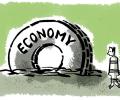
Moody's Investors Service on Friday projected India's growth at zero per cent for the current fiscal and said the negative outlook on sovereign rating reflects increasing risks that GDP growth will remain significantly lower than in the past. The outlook also partly shows weaker policy effectiveness to address economic and institutional issues, it noted in the update to its November 2019 rating forecast.
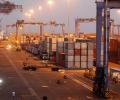
Developed countries are relaxing restrictions on economic activity at a faster rate than expected. Global demand for consumer goods, intermediates and commodities is growing at a fast pace. Most exporters are flushed with orders, says T N C Rajagopalan.

Indian technology industry has a "big opportunity" despite global macroeconomic challenges, said Rishad Premji, chairman of IT services firm Wipro, on Wednesday as he spoke about how Covid-19 had changed work. "My confidence is driven by two things: the rapid pace of digitisation across the world, and the shift in the mindset of stakeholders who engage with us as an industry," said Premji in Bengaluru while addressing industry leaders and civil servants at the Invest Karnataka 2022, the state's Global Investors Meet (GIM). Businesses are using technology for customers and employees: a trend marked by the shift to cloud computing and leverage of data.

Efforts of the government have been successful in reining in the growth of population, she said in a written reply.

The ineptness of successive American presidents, from Bush the Younger to Joe Biden the Old, combined with the cluelessness that Americans demonstrate in foreign lands, contrasts with the Chinese leadership's seemingly singular focus on the accumulation of wealth and power, asserts T N Ninan.
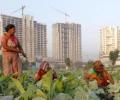
The land acquisition bill is a catalyst to investment and passing the bill will improve India's business environment.

Rating agencies Crisil and Icra on Monday revised down their India growth projections for the current fiscal and the second quarter mainly due to the ripple effect of slowdown in global growth and mixed crop output. Crisil downgraded the India growth forecast by 30 bps to 7 per cent while Icra pegged the economic expansion at 6.5 per cent for the second quarter of FY2022-23. "We have revised down our forecast for real gross domestic product growth to 7 per cent for fiscal 2023 from 7.3 per cent, primarily because of the slowdown in global growth that has started to impact our exports and industrial activity.

This is a high-stakes strategic conflict between a power which wants to preserve the status quo in its favour and one which wants to usurp that throne. The rest is all theatre, says Harsh V Pant.

India's climate change goals are turning combustible. On the one hand, a protracted dispute between the government and manufacturers over subsidies threatens to slow the pace of electric vehicle (EV) sales. On the other hand, repeated assertions by different arms of the government over banning sales of new fossil fuel-fired vehicles have queered the pitch for energy investments. Before we address the issue of the recommended diesel vehicle ban in the recent report on energy transition, issued months before the next round of global climate talks begin in Dubai in November, let's look at what's at stake.

Billionaire Mukesh Ambani's Reliance Industries Ltd on Friday announced to raise Rs 7,350 crore from two investors -- Singapore's sovereign wealth fund GIC and Global alternative asset firm TPG -- by selling a stake in group's retail arm.

Movements in gold prices will depend on the US' interest rates.

The prime minister took no names but made an apparent reference to reports about "rate card" for different government jobs in the Trinamool Congress-ruled West Bengal and prevalence of "cut money" in the state.

The recovering valuations, will lead to enhanced optimism among investors about funding startups.
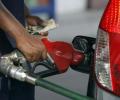
India's demand for petroleum products like petrol and diesel will grow by 7.73 per cent in 2022, the fastest pace in the world, an OPEC report said. India's demand for oil products is projected to rise from 4.77 million barrels per day (bpd) in 2021 to 5.14 million bpd in 2022, OPEC said in its monthly oil report. The growth in demand is the fastest in the world ahead of 1.23 per cent of China, 3.39 per cent of the US and 4.62 per cent of Europe.

S&P Global Ratings on Monday said systemic risk in Indian banks is likely to remain high in the wake of the second wave of COVID-19 and high proportion of weak loans. S&P estimates the weak loans in banks at 11-12 per cent of gross loans.

Don't exit from growth-style funds as they may benefit next from a shift in investor preference.

'When fund managers talk of being bullish for the long term, they assume strong economic growth.' 'That is what they have assumed every year, naively believing the pronouncements and promises of ministers.' 'Unfortunately, they have been wrong year after year,' observes Debashis Basu, editor, www.moneylife.in.

'The prospects for both India and the global economy is that we are headed towards a very difficult time.' 'I see very uncertain at least 8-10 months for both India and the rest of the world.'

Because of India's weak fiscal position, the plethora of debt-burdened infrastructure companies and the poor asset quality of public sector banks, economic growth in 2015-16 may be limited to about six per cent, say Shankar Acharya.

The Indian aviation sector is on the cusp of a change as airlines look to induct a record number of aircraft. This, analysts said, will put the sector on a growth runway, though keeping it viable for only long-term investors. According to Vinit Bolinjkar, head of research at Ventura Securities, expectations of strong air traffic, coupled with low penetration, is the prime reason for a solid long-term outlook.

Jaishankar said the world has experienced its consequences in terms of higher costs and shortages of foodgrains and fertilizers and fuel.
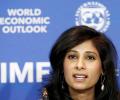
The IMF on Tuesday cut India's economic growth forecast by 0.5 percentage points to 9 per cent for the current fiscal year, with its chief economist Gita Gopinath saying that the slight downgrade is mainly due to the impact of the spread of the Omicron variant. "If you look at the 2021-22 fiscal year, we have a slight downgrade of -0.5 percentage points and for the next fiscal year 2022-23 we have a slight upgrade of 0.5 percentage points. So, growth for the previous fiscal year is now nine per cent and for this year now is at nine per cent. We moved it up slightly," Gopinath told reporters during a news conference in Washington. In its latest update of World Economic Outlook on Tuesday, the International Monetary Fund has cut India's economic growth forecast to 9 per cent for the current fiscal year ending March 31, joining a host of agencies which have downgraded their projections on concerns over the impact of the spread of Omicron on business activity and mobility.

NTPC was the top gainer in the Sensex pack, rallying over 4 per cent, followed by HUL, PowerGrid, Reliance Industries, ITC, UltraTech Cement and Bajaj Finance. NSE Nifty surged 186.15 points to finish at 14,744.

The government expects indirect tax collection to be lower than the Budget Estimate (BE) of Rs 13.38 trillion this fiscal year, despite prospects of netting goods and services tax (GST) in large amounts, Revenue Secretary Tarun Bajaj has said. "Indirect tax collection may see lower realisation than budgeted on account of cuts in excise and customs duties. "We could see a shortfall of about Rs 1.5 trillion on account of those," he told Business Standard.

The Reserve Bank on Friday retained the GDP forecast for the current financial year at 9.5 per cent and flagged global semiconductor shortages, elevated commodity prices and potential global financial market volatility as downside risks to economic growth. In his address after the three-day meeting of the rate-setting panel, RBI Governor Shaktikanta Das said recovery in aggregate demand gathered pace in August-September, and it is reflected in high-frequency indicators, like railway freight traffic; port cargo; cement production; electricity demand; e-way bills; GST and toll collections. "The ebbing of infections, together with improving consumer confidence, has been supporting private consumption," he said, and added the pent-up demand and the festival season should give further fillip to urban demand in the second half of the financial year.

Assocham told Modi policy makers needed to act fast to "bullet proof" India from global jitters.

Good salary combined with benefits such as extra allowances and perks are also playing a major role in bringing back professionals to the country, according to 25 per cent of the employers in the TimesJobs.com study.

India's rising GDP may have propelled the middle class to become richer, buy new cars, travel around the world and build assets, but it further pushed the economically disadvantaged and poor into poverty and drudgery, says Devanik Saha.

'Short term volatility is likely due to various factors, global and domestic; investors may use this as an opportunity to increase the allocation to equities.'
